The European summer and the art of living without air conditioning
A cultural, historical, and sensorial look at Europe’s relationship with heat, comfort, and the air that moves through open windows
For decades, we have tried to explain the European summer through meteorology. We talk about recent heat waves, the lack of infrastructure, and the urban idiosyncrasies that reveal ancient alleys and century-old buildings. But the truth runs deeper. Europeans’ relationship with air conditioning transcends the climatic issue and enters the realm of culture, memory, and how each society understands what it means to feel comfortable. Where some see a technical necessity, others see a philosophy of life.
Long before modern inventions, opening windows was more than a daily gesture. It was almost a manifesto. Fresh air symbolized health, vitality, and renewal. In villages, walled cities, or palaces, the flow of wind was always interpreted as an invitation for life to enter. Instead of turning on a machine, people cultivated the habit of letting the house breathe. It’s a simple gesture, yet one that has endured for centuries as a silent ritual of well-being.
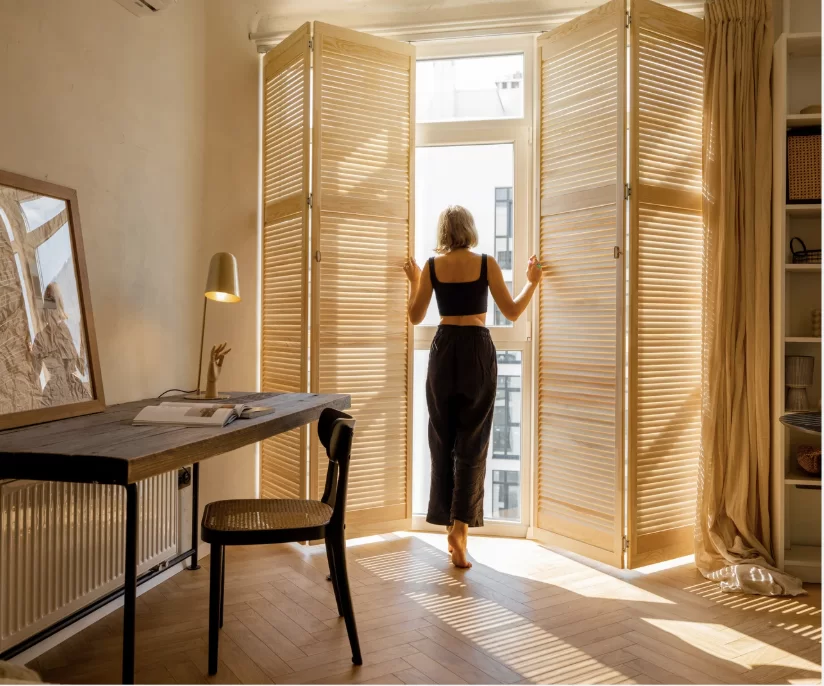
Strolling through southern Europe, this outlook becomes even more evident. Traditional architecture was designed to cool without mechanical effort: thick walls that hold the chill even on scorching days, stone floors that stay cool, shutters that control light and cast precise shade, internal courtyards that channel the breeze. The idea of comfort has always been deeply tied to house design and natural solutions. Air conditioning, therefore, was not merely dispensable. It was incongruous.
In the post-war era, when mass consumption began to spread around the world, air conditioning became a symbol of a specific modernity, closely associated with the American imagination. To many Europeans, it represented an artificial, excessive, and, in a way, unnecessary ideal. While U.S. skyscrapers rose wrapped in powerful cooling systems, Parisian cafés still exhaled the warm summer air and the sound of improvised fans. This resistance was not only technical but also symbolic. It was almost an aesthetic stance.
In cities like Paris, Rome, and Lisbon, that spirit endures. Anyone who has lived through a European summer knows the ritual well: discreet fans, open windows creating cross-ventilation, and a glass of white wine that serves more as a gesture of refreshment than celebration. There’s an elegant informality to this custom. A light sweat isn’t seen as negligence but as a natural part of the season. A shared humanity. The idea of fully controlling the environment, of erasing any trace of warmth, is perceived as unnatural.
There’s also a curious, deeply cultural layer: the Mediterranean belief that cold drafts can cause illness. In Italian, the term colpo d’aria refers to a sudden breeze deemed dangerous. It’s not uncommon to hear grandparents warning grandchildren about leaving windows open after sunset, or to see people shielding their necks on the metro when they feel a stronger gust. It’s a tradition passed down orally that shapes everyday relationships with temperature in unseen ways.
With the growth of global tourism and the expansion of contemporary hospitality, Europe had to reconcile its historical culture with the expectations of travelers accustomed to cooled environments. Discreet solutions emerged. Boutique hotels hide cooling systems behind antique grilles or embed air vents into nearly imperceptible ceilings. The goal is to preserve the original aesthetic without sacrificing comfort. It’s a way of adapting without betraying the spirit of the place.
Even so, the essence remains. For many Europeans, comfort means harmony with the environment, not combat. It means accepting the heat as part of the summer experience, as an extension of the city, as the body’s natural rhythm. A philosophy that departs from the pursuit of absolute thermal neutrality and embraces a more sensory way of life—open to what comes from outside, to what changes, to what circulates.
In the end, understanding why Europeans avoid air conditioning is not just about uncovering a habit. It’s about comprehending a way of being that values the air passing through windows, the light dancing on linen curtains, and the silence without machines. It’s realizing that summer, for them, doesn’t need to be conquered. It simply needs to be lived.