
At Watches & Wonders 2026, the Maison didn’t merely show new timepieces; it made a case for the watch as the ultimate act of civilization.
There is a moment, at Watches & Wonders each April in Geneva, when the air itself seems to change pressure. The halls of the Palexpo fill with a particular species of quiet, the hush of people confronted with objects that have no business being as beautiful as they are. This is the fashion week that fashion week wishes it could be: no street style circus, no front-row theatrics, just the distilled obsessions of the world’s great watchmaking houses laid out under museum lighting, ticking.
Cartier arrived at its 2026 edition not with a mood board or a marketing concept, but with a thesis. The Maison has long called itself the watchmaker of shapes, a phrase that sounds like branding until you understand what it actually means. Since the early twentieth century, Cartier has been doing something the rest of the industry largely declined to attempt: treating the watch case not as a container for a movement, but as a sculptural form in its own right. Square, curved, oval, irregular, each silhouette demands its own bespoke engineering, its own vocabulary of craft. This year, Cartier made that argument visible.

The boldest move was perhaps the most expected: the Roadster is back. Originally launched in 2002, the watch disappeared from the collection long enough to become genuinely coveted, the way things only become coveted when they’re gone. Its return is not a nostalgic exercise. Cartier’s designers went back to the automobile codes that inspired the original, the streamlined fuselage of mechanical speed, and sharpened everything. Proportions were redrawn. The crown was integrated into the case with such precision that the whole feels poured rather than assembled. The interplay of sapphire crystal and polished metal creates a kind of visual unity that, once you understand how difficult it is to achieve, becomes impossible to unsee.
Inside, the Roadster carries one of two signature self-winding movements: the 1847 MC for larger models, the 1899 MC for medium models. Cartier has never been primarily a movement house in the way of, say, Patek Philippe or A. Lange & Söhne, and it doesn’t pretend to be. What it is is a house that knows exactly how much technical sophistication a watch needs to be precisely what it’s meant to be. The Roadster needs to feel alive on the wrist, purposeful, a little dangerous. It does.
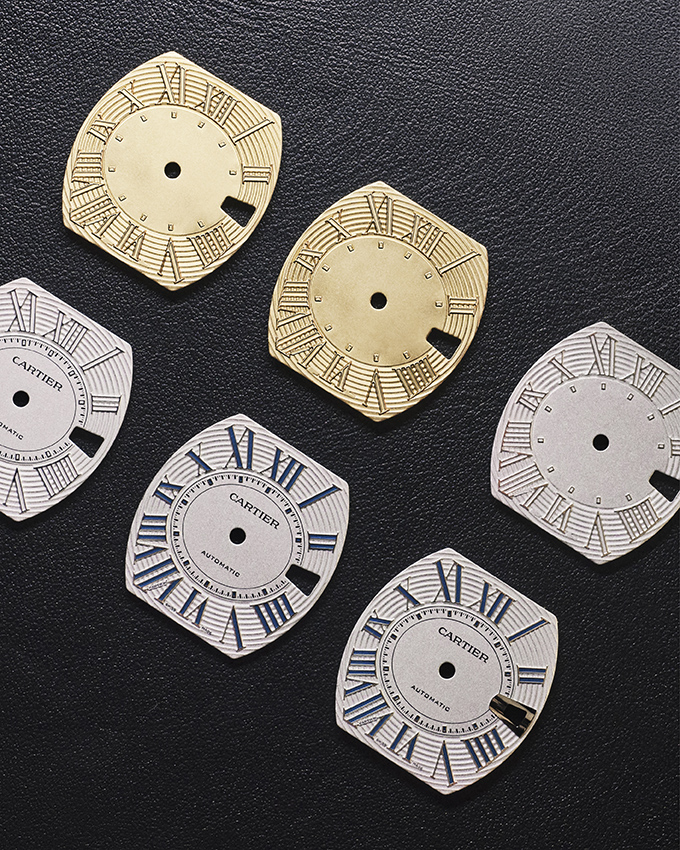
If the Roadster represents Cartier’s sporting side, the Santos-Dumont is its philosopher, a watch that has been contemplating the meaning of elegance since 1904, when Louis Cartier made one for his friend Alberto Santos-Dumont, the Brazilian aviator who needed to check the time without taking his hands off the controls. The watch that resulted was the first men’s wristwatch made for practical use. Everything that came after, the entire modern landscape of men’s horology, owes something to that moment.
The 2026 reinterpretation centers on two things: a dial in gilded obsidian and a bracelet that is, frankly, an engineering marvel in miniature. The obsidian, a volcanic stone from Mexico whose iridescence is due to trapped air bubbles, has been cut to just 0.3 millimeters thick. At that depth, it behaves more like glass than stone, and working with it requires the kind of patience that makes you understand why so few houses bother. The gold bracelet, inspired by flexible metal designs from the Manufacture’s 1920s archive, is composed of 394 individual elements, every 1.15 millimeters in profile. The sensation of wearing it, Cartier promises, is of something that barely exists, metal that flows.
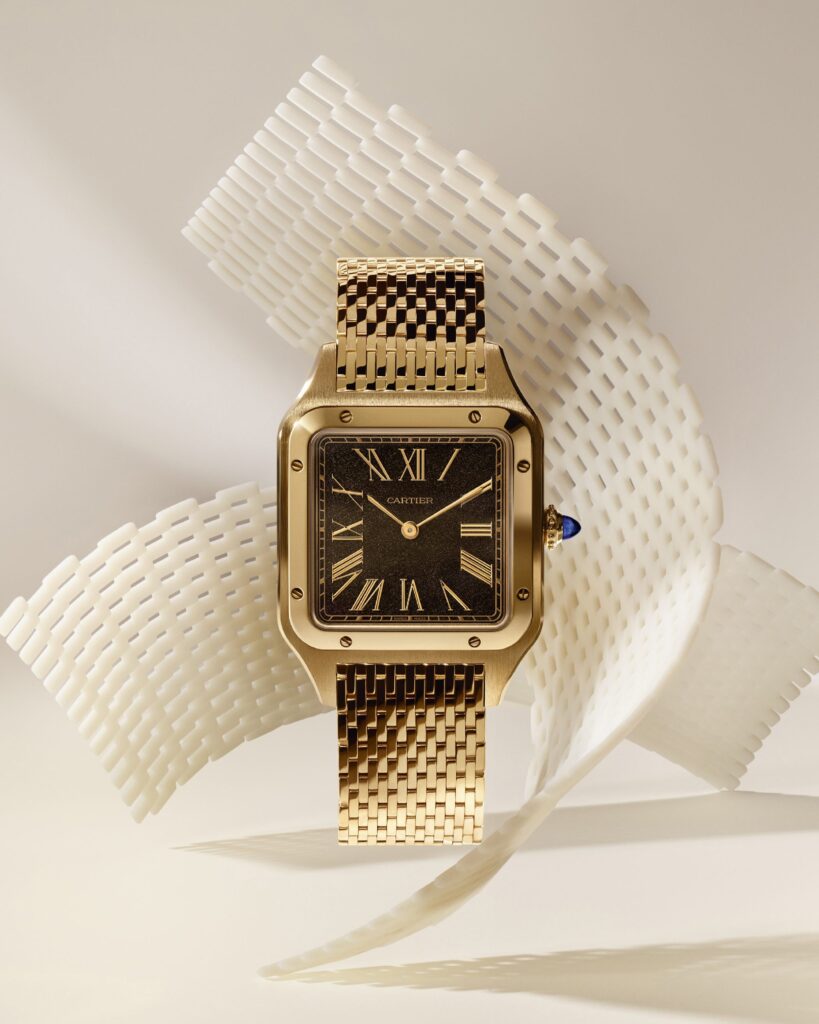
The Baignoire, French for bathtub, named for its oval curve, is one of those Cartier designs that sits comfortably between jewelry and watchmaking without fully belonging to either. The 2026 version adorns it with the Clou de Paris motif: a grid of pyramid-shaped studs that has been part of Cartier’s decorative vocabulary since the early 1920s. In monochrome yellow gold, covering both the bracelet and the dial in unbroken continuity, the effect is architectural rather than merely ornamental. Rhythm and structure, Cartier says, and that’s exactly right. The polishing has been done entirely by hand, a process that requires revealing the gold’s brilliance without flattening the relief. One hundred brilliant-cut diamonds are snow-set on the dial; inverted pavilion diamonds sit on the case. The technical precision required for either setting technique is formidable. Together, they are extraordinary.
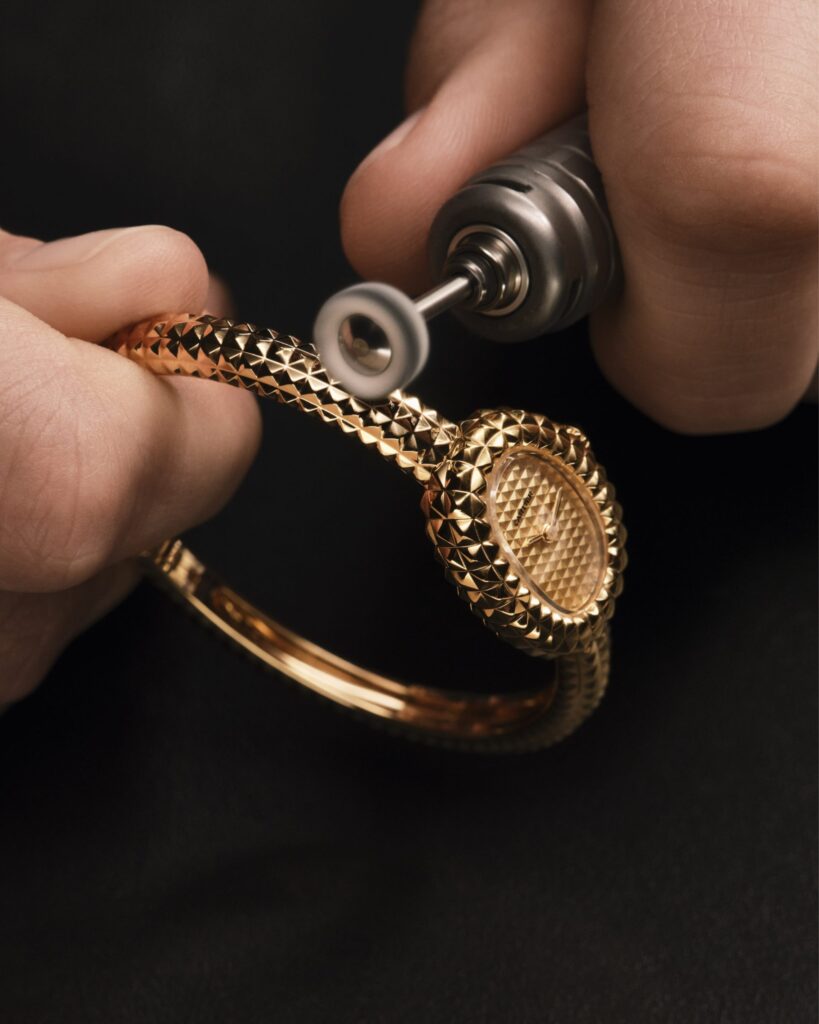
And then there is the Myst. If you have ever stood before a piece of Schlumberger jewelry at the Met and felt mildly underdressed by comparison, the Myst de Cartier will produce a similar sensation. This is a watch in the tradition of Jeanne Toussaint, Cartier’s legendary creative director from the 1930s through the 1960s, the woman whose restless imagination turned the Maison into a theatre of extraordinary objects. The Myst is sculptural, opulent, and flamboyant in the way that only things made with absolute technical control can be. Its alternating curves of onyx and pavé diamonds are hand-lacquered, one spot at a time, by craftsmen at Cartier’s Maison des Métiers d’Art in Switzerland. One hundred and twelve hours of gem-setting went into the bracelet alone. It wears on an elastic strap without a clasp, slipping onto the wrist with an ease that required, Cartier notes with characteristic understatement, “extensive research and development.”
Pierre Rainero, Cartier’s Director of Image, Style and Heritage, described it simply: “Volume and movement.” He is right. But he is also modest.

The centerpiece of the 2026 collection, the piece that will be argued about in collector forums for years, is the Crash Squelette, the tenth edition of Cartier Privé. Each year, Cartier Privé takes an iconic shape from the archive and reimagines it with significant technical ambition. The Crash, created in 1967 with its deliberately distorted, asymmetrical case, is Cartier’s most surreal design and perhaps its most culturally resonant. Part melted clock, part automotive accident, entirely unlike anything else in watchmaking.
For the skeleton version, Cartier’s engineers developed the Manufacture 1967 MC movement from the ground up, manually wound, housing 142 components, specifically to inhabit the Crash’s irregular case without compromise. The bridges, which in a conventional skeleton movement form the visible architecture of the mechanism, have been shaped into Roman numerals, then hand-hammered using a technique that requires nearly two hours of work per piece. The movement appears to be in motion even when standing still, the crown seeming to pull the entire construction downward with a kind of deliberate gravity. This construction is patented. Only 150 numbered examples will exist.
It is the kind of object that makes the case, quietly but irrefutably, that watchmaking at its finest is not a craft in the service of timekeeping. It is timekeeping in the service of art.
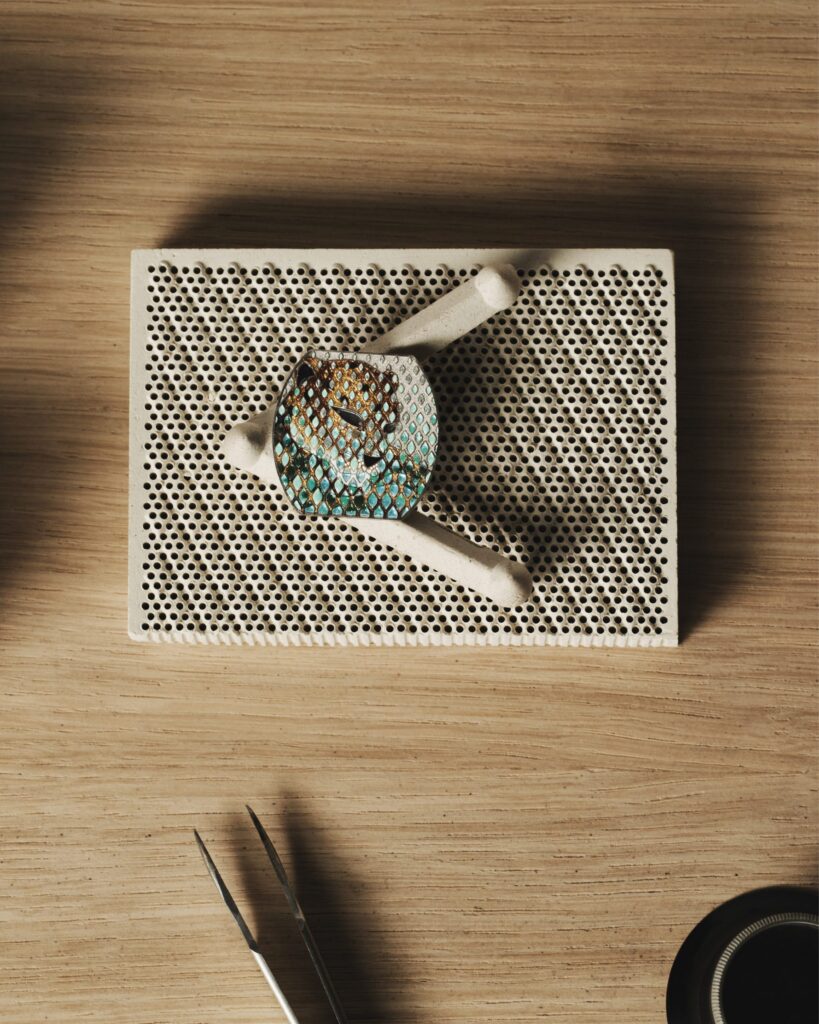
Watches & Wonders occupies a peculiar place in the cultural calendar — too technical for the fashion press, too beautiful for the trade press, too expensive for everyone, and somehow indispensable to all of them. What it actually is, when stripped of the commerce, is a gathering of people who believe that how something is made is as significant as what it does. In that sense, Cartier’s 2026 collection is not merely a product launch. It is a position statement.
The watch, in the age of the phone and the smartwatch, has shed its utility and kept its meaning. What remains is pure: the human desire to possess something made well, to wear time on the wrist not to know the hour but to carry, close to the skin, the evidence of what patience and precision and imagination can produce. Cartier, this April in Geneva, reminded everyone in the room what that looks like when it’s done without compromise.
The clocks, as ever, were ticking. The craftsmanship was silent.
Watches & Wonders Geneva 2026 ran April 1–7. The Cartier Roadster, Santos-Dumont, Baignoire Clou de Paris, Myst de Cartier, and Crash Squelette are available through Cartier boutiques and cartier.com.
